
Zishi Han
IN CONVERSATION
21.08.26
F R A G M E N T S
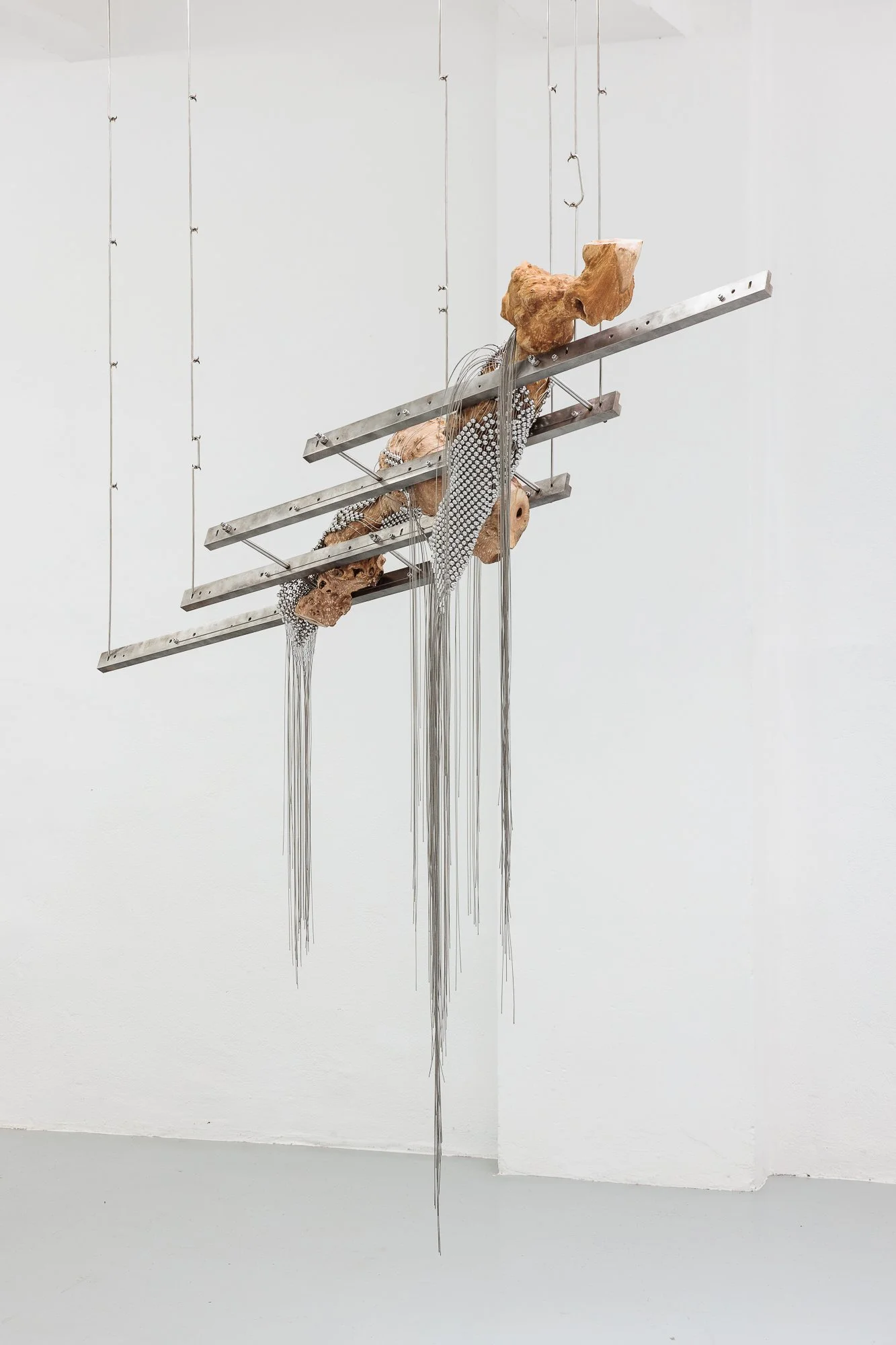
Zishi Han was trained as an engineer before studying at Städelschule in Frankfurt. He builds structures that contain, entangle, leak and malfunction. An exuvia still holds the shape of a body, even though that body has already moved elsewhere.
For our readers encountering your work for the first time, please take us through your background.
I was born in Beijing and came to art relatively late. Before studying at Städelschule in Frankfurt, where I graduated in 2024, I was trained as an engineer and designer. I think that background still sits somewhere in the way I think and work. I’m drawn to structures: how things are held together, how forces move through them, how a system organises bodies and space.
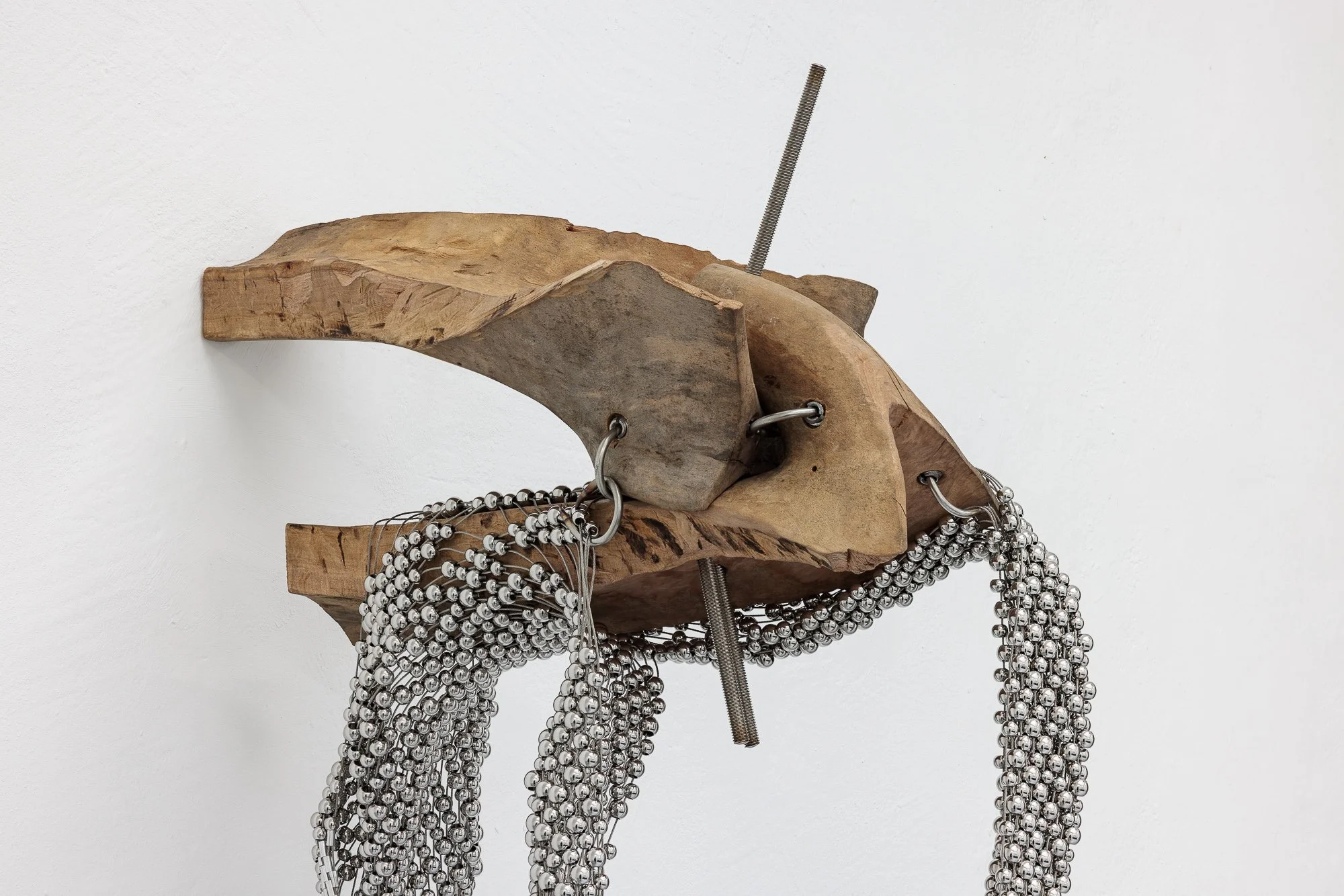
Over time, I started thinking about structures less as functional systems and more through the relationships we form with them. They contain, entangle, leak, and malfunction. I’m interested in the moment when something structural starts to feel bodily, and when an object begins to suggest a relationship of dependence, desire, or control.
I grew up in Beijing and have lived in Europe for more than ten years. Moving between different places has made me sensitive to how power takes spatial and material forms. Architecture, infrastructure, even the atmosphere of a room can quietly tell us how to move and behave. Much of my work begins somewhere within these relationships.
ZH
Tell us about your series, exuviae.
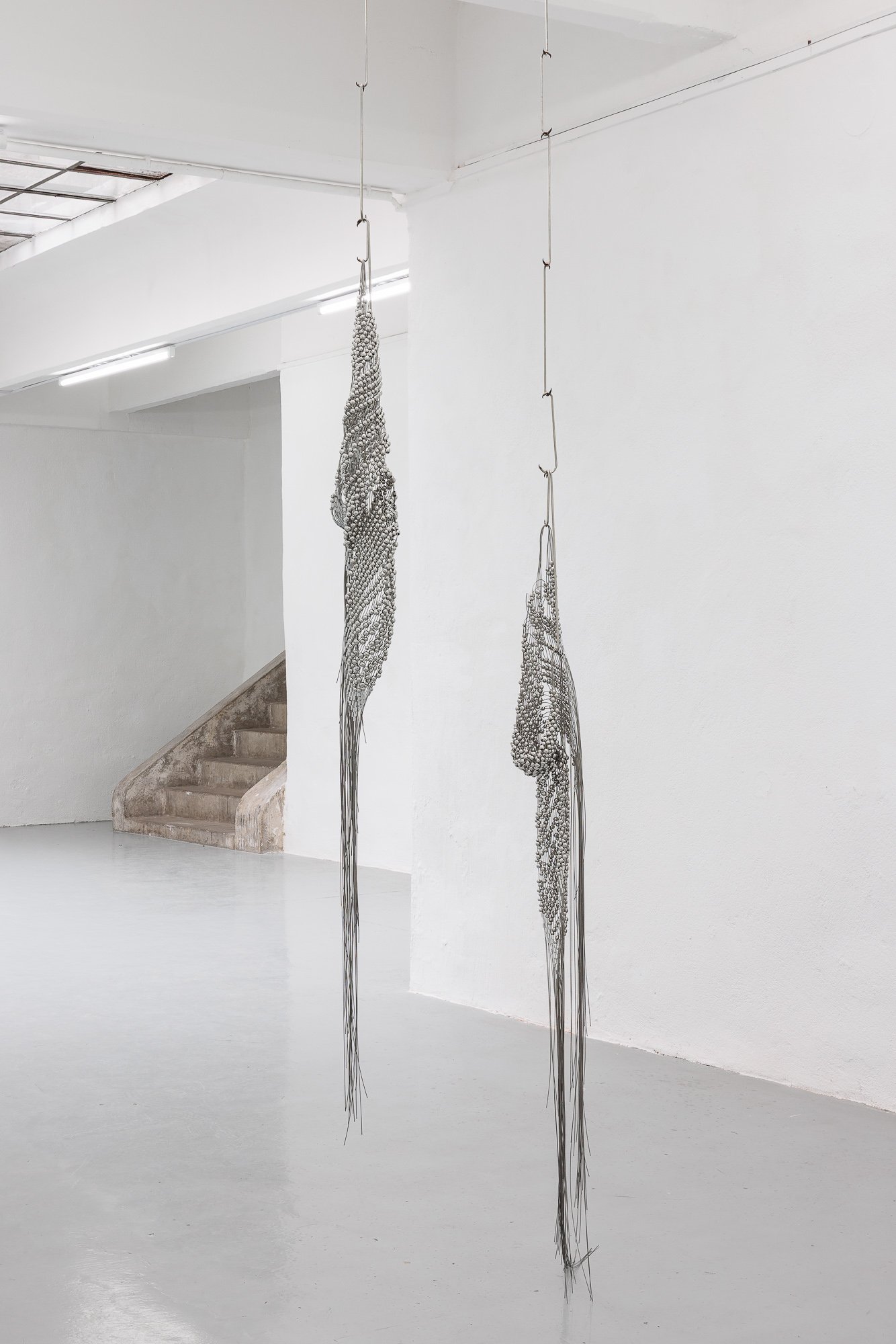
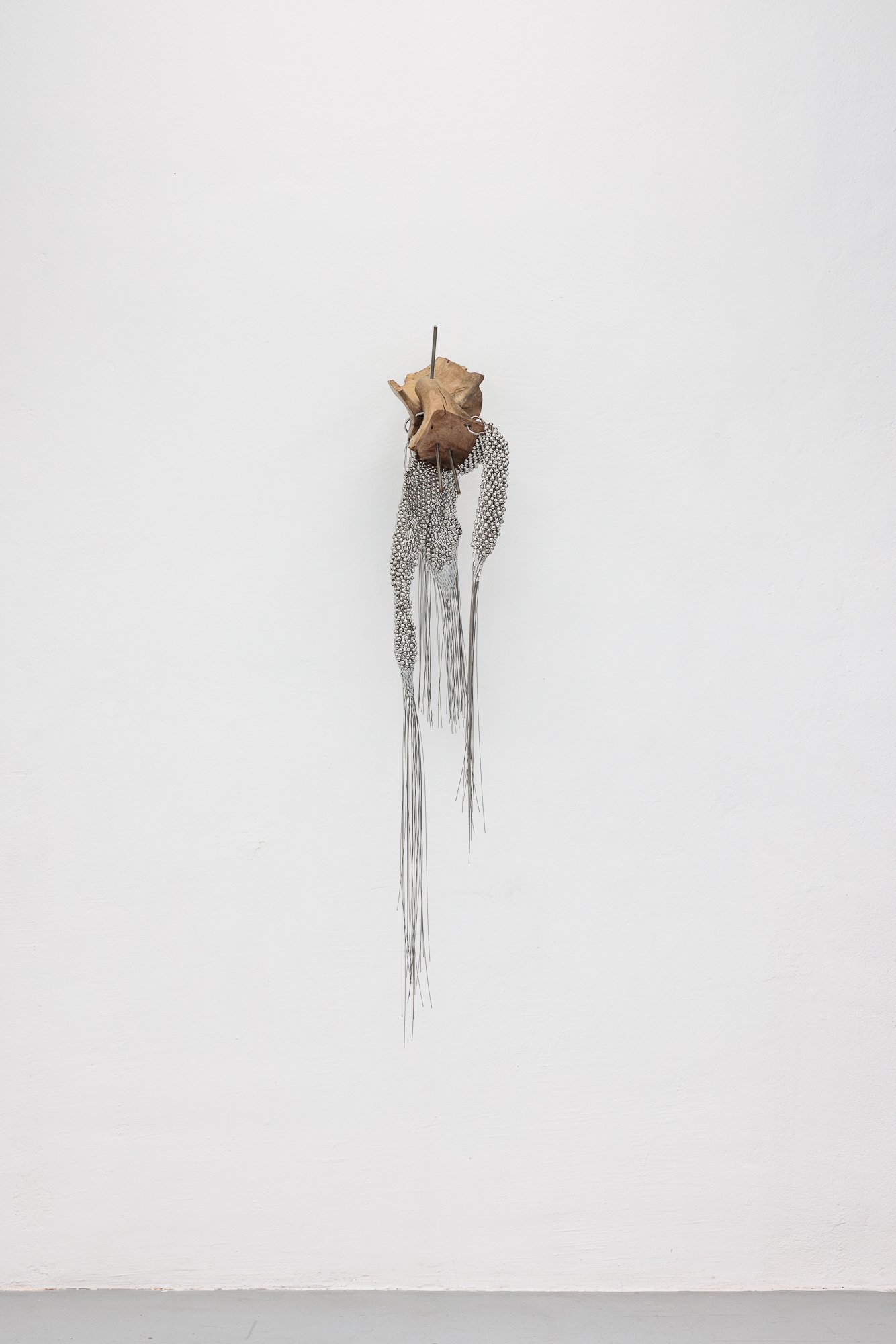
exuviae refers to the skin or shell left behind when an insect molts. I was attracted to the word because an exuvia still holds the shape of a body, even though that body has already moved elsewhere. It is both an enclosure and a trace.
The series developed using aluminium chains, machined metal parts, cables and bass shakers. The works hang and flow like ghostly membranes. Low-frequency vibrations travel through the metal, so something that looks rigid is constantly trembling and shimmering.
I’m drawn to this contradiction. The structures can appear controlling or protective, while at the same time seeming nervous and vulnerable themselves. There is a strange attachment between the body and what contains it, whether that is a physical, psychological or social structure. Sometimes I think of this relationship as slightly masochistic: we become attached to structures that restrict us, perhaps even desire them.
The series keeps changing according to where it is installed. I think of each work as temporarily inhabiting a space, almost like a parasite finding a host.
ZH
In Hairpin Beneath, you combine performances with film. Can you tell us more about this piece?
Hairpin Beneath is an ongoing collaboration with Wei Yang that began from our shared interest in historical Chinese homoerotic literature, and how these stories might speak to queer lives in China and the Chinese diaspora today. We started by translating Biàn ér chāi, a late-Ming anthology of homoerotic stories. Its title describes a man taking off his ceremonial headgear and putting on a woman’s hairpin.
The first video came quite unexpectedly. Wei and I were discussing one of the stories, Qíng Zhēn Jì, and as we talked he gradually slipped into one of its characters. At some point it became difficult to tell when he was speaking as the character and when he was speaking as himself. We became interested in staying within this ambiguity, where historical fiction can become a way of approaching something autobiographical, perhaps also something difficult to say directly.
The project has since become more theatrical. In the second video, two queer friends perform our adaptation of Qíng Zhēn Jì. The live performance then reenacts scenes from the video inside the exhibition space, while Wei dubs the video in real time. His voice moves between narration, acting and confession.
I like that several realities can exist at once. The historical story, the performers’ bodies, Wei’s own experiences, desire and fantasy begin to overlap. We are interested in allowing the historical text to be inhabited again, and seeing what happens when someone begins to recognize themselves inside a story written centuries ago.
ZH
You also combined film and physical structures in your exhibition FATAL ATTRACTION. What was the intention behind this exhibition and the process of assembling it?
FATAL ATTRACTION grew out of my ongoing work with moths and their attraction to light. I started thinking about what happens after that attraction: the moth approaches the light and enters an apparatus of observation. It can be gathered, photographed, classified, immobilized, preserved. Attraction becomes a way of making a body visible and legible.
The new film, The nocturnal flights of stillness, follows this through three sites. I filmed living moths around a UV light in Lübeck, preserved specimens in a scientific collection in Hamburg, and moths immobilized for sensory experiments in a neuroethology lab in Konstanz. Across these environments, the moth moves through different states of observation and control.
Running alongside these sequences is a human figure who sits still, blindfolded in front of the camera. Over time, his features dissolve into abstraction and become increasingly unrecognizable. Unbeknownst to the viewer, he is making confessions of personal trauma, forbidden impulses and disturbing dream imagery drawn from horror cinema.
I was thinking about visibility as something we constantly negotiate. There is desire in being seen and recognized, alongside the vulnerability of becoming exposed to someone else’s gaze or to a system that wants to understand and define you. This became closely connected to how I was thinking about queer visibility.
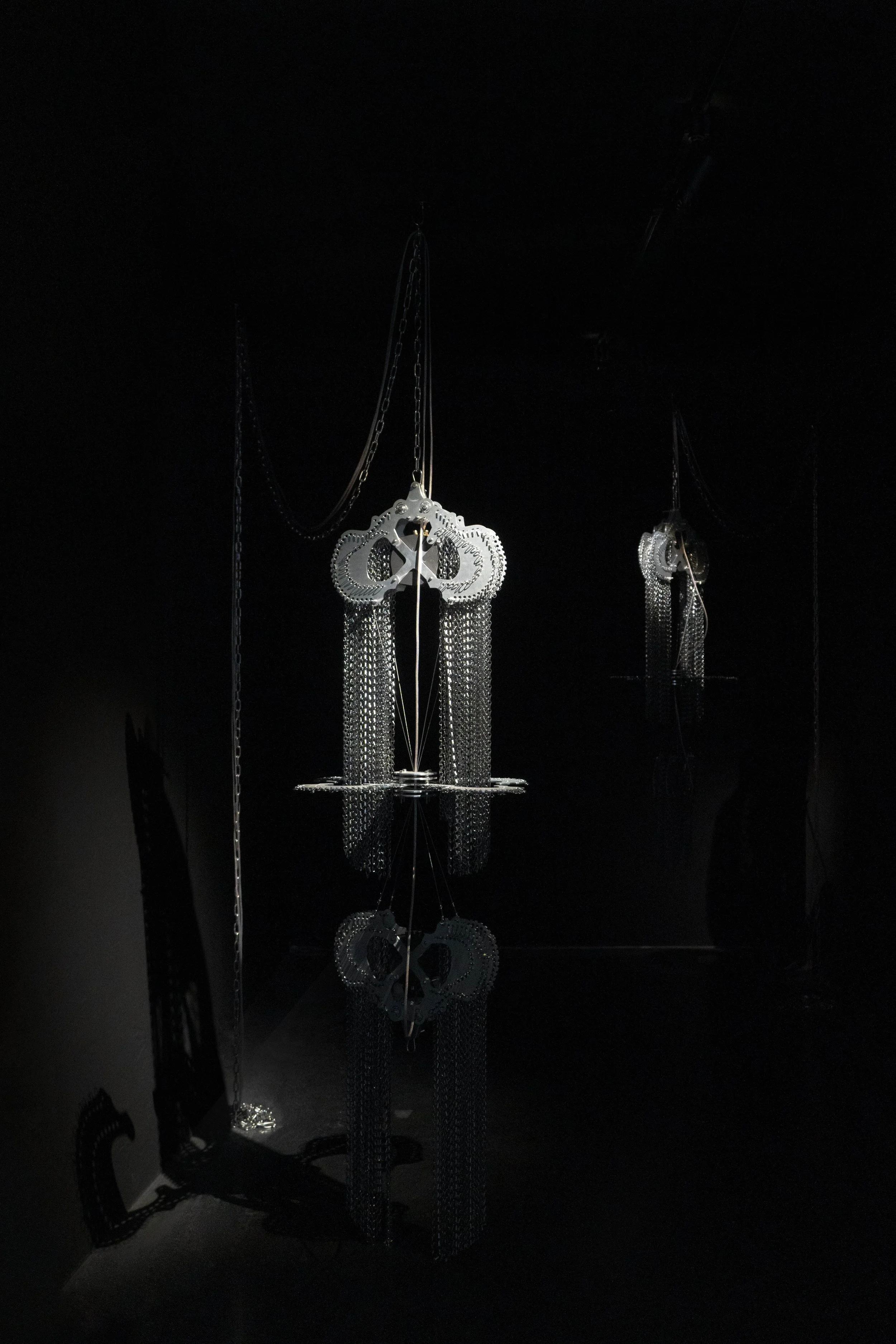
I wanted this tension to move outside the film and into the exhibition space. Two street lamp posts became supports for the Exuviae sculptures, made from aluminium chains associated with fly screens. They form porous barriers: bodies and air can pass while insects are supposed to remain outside. Bass shakers make the chains continuously tremble, so the boundary never feels completely stable.
The exhibition came together through these relationships between light, bodies and structures. Film, vibration, objects and shadows started to leak into each other. I wanted the space itself to hold this tension between attraction and exposure, and between the desire for visibility and the vulnerability that comes with it.
ZH
Where do you draw inspiration from?
It often starts with a feeling in a specific space. I might enter somewhere and become aware of the density of the air, the way a structure contains the body, or a small sense of attraction or discomfort that I can’t immediately explain. I tend to stay with that feeling for a while.
From there, I start looking at what is producing it. Sometimes it is architectural, sometimes something almost invisible: humidity, light, vibration, a smell, or the way bodies are directed through a space. These encounters often lead me toward materials and research, and gradually into larger questions around power, desire and vulnerability.
I like following these sensations and seeing where they lead. A lot of my work develops this way: something elusive or atmospheric slowly finds a physical structure.
ZH
What’s next for Zishi Han?